So very much of pure prayer seems to be the process of first discovering, rather than requesting, the will of our Father in heaven and then aligning ourselves therewith. The "Thy will be done" example in the Lord's Prayer reached its zenith in the Savior's later prayer in Gethsemane and in His still later submittal on the cross: "Nevertheless not as I will, but as thou wilt." (Matthew 26:39.) When we do conform to His will, God will pour forth special blessings from heaven upon us, as was the case with Nephi, the son of Helaman. Of him the Lord said, "And now, because thou hast done this with such unwearyingness, behold, I will bless thee forever; and I will make thee mighty in word and in deed, in faith and in works; yea, even that all things shall be done unto thee according to thy word, for thou shalt not ask that which is contrary to my will." (Helaman 10:5. Italics added.)
Sunday, October 20, 2013
Today's Maxwell Quote
From All These Things Shall Give Thee Experience (1980), 93-94:

Saturday, October 19, 2013
Salvation as Politics
When Judas the Hammerer went to war against the Persians, he began to have success against them. The account in 1 Maccabees says of his military victories that
εὐοδώθη σωτηρία ἐν χειρὶ αὐτοῦSo the idea that salvation could be a political or military matter was certainly attested in ancient Judaism. The ancient notion of salvation incorporates political and military success, but includes much more than those notions. It also encompassed ideas of healing, and of eternal life.
salvation prospered in his hand (1 Maccabees 3:6)
Today's Maxwell Quote
From Things As They Really Are (1978), 42:
How tragic it is that so many mortals are mercenaries for the adversary; that is, they do his bidding and are hired by him—bought off at such low prices. A little status, a little money, a little praise, a little fleeting fame, and they are willing to do the bidding of him who can offer all sorts of transitory "rewards," but who has no celestial currency. It is amazing how well the adversary has done; his mercenaries never seem to discover the self-destructive nature of their pay and the awful bankruptcy of their poor paymaster!
Friday, October 18, 2013
Prophets After Our Own Hearts
My friend and colleague, Ralph Hancock, has a very thoughtful piece in First Things (of all places) about one-sided openness to new revelation. His considered commentary should be carefully read.
It seems to me that lobbying for a revelation to support things that we want leaves us vulnerable to a particular vice the Book of Mormon warns us against:
It seems to me that lobbying for a revelation to support things that we want leaves us vulnerable to a particular vice the Book of Mormon warns us against:
24 Yea, wo unto this people, because of this time which has arrived, that ye do cast out the prophets, and do mock them, and cast stones at them, and do slay them, and do all manner of iniquity unto them, even as they did of old time.
25 And now when ye talk, ye say: If our days had been in the days of our fathers of old, we would not have slain the prophets; we would not have stoned them, and cast them out.
26 Behold ye are worse than they; for as the Lord liveth, if a prophet come among you and declareth unto you the word of the Lord, which testifieth of your sins and iniquities, ye are angry with him, and cast him out and seek all manner of ways to destroy him; yea, you will say that he is a false prophet, and that he is a sinner, and of the devil, because he testifieth that your deeds are evil.
27 But behold, if a man shall come among you and shall say: Do this, and there is no iniquity; do that and ye shall not suffer; yea, he will say: Walk after the pride of your own hearts; yea, walk after the pride of your eyes, and do whatsoever your heart desireth—and if a man shall come among you and say this, ye will receive him, and say that he is a prophet.
28 Yea, ye will lift him up, and ye will give unto him of your substance; ye will give unto him of your gold, and of your silver, and ye will clothe him with costly apparel; and because he speaketh flattering words unto you, and he saith that all is well, then ye will not find fault with him. (Helaman 13:24–29)
Today's Maxwell Quote
From Things As They Really Are (1978), 38-39:
The living prophets, if they seem monotonous, are simply reporting what they know from the living God. The fact that it is essentially the same message from dispensation to dispensation merely confirms the truth of such utterances. Monotony does not lessen verity. We may grow tired of hearing that the earth is round, but our boredom will not change its shape.
Thursday, October 17, 2013
A Story of Trust
I am struck by a passage in an article about why it is a waste of time to get an MBA if you are over 40:
As a floor trader, you learned you could trust people’s word. Off the floor, you really can’t trust anyone. You have to verify everything, and people will stick a knife in your back. Write things down, record things, have witnesses if possible. People will lie, make things up, and change history to fit outcomes that they want.It is nice to know that there are some places where people are honest and trustworthy. I find it interesting that many academics would be inclined to think that the trade floor would not be one of those places.
Today's Maxwell Quote
From Things As They Really Are (1978), 35:
Others believe their morals are superior to God's. Because he does not adopt their issues or jump the hurdles they wish him to jump, they are not going to extend themselves in worship of him. The Lord describes such individuals as "walking in darkness at noon-day." (D&C 95:6.) The living God will not be disregarded.
Wednesday, October 16, 2013
Further Thoughts on the Latest Pseudo-Scholarly Theory
I pointed the other day to a theory making the rounds that Jesus was the invention of the Roman government. This does not pass the smell test.
(1) The earliest mention of the Christians by a Roman author is Tacitus who holds a negative attitude toward the Christians.
(2) He mentions the persecution of the Christians by Nero, who obviously did not think highly of them either.
(3) The next mention is by Pliny, who has just tortured some of them and put them to death.
(4) Pliny's mention is in a letter to the emperor Trajan, whose reply says that anyone stubborn enough to continue to adhere to Christianity is certainly worthy of death.
If the Roman government were pushing worshiping Jesus, why were they then killing the people who actually did what the government purportedly wanted them to do? Does any of this sound like the Roman government invented Christ for their own political purposes?
Today's Maxwell Quote
From Things As They Really Are (1978), 24-25:
There have been those who have failed or who have been treasonous to their trust, such as David, Solomon, and Judas. God foresaw the fall of David, but God was not the cause of it. It was David who from the balcony both saw and sent for Bathsheba. But God was not surprised by such sad developments.
God foresaw but did not cause Martin Harris's loss of certain pages of the translated Book of Mormon; he made plans to cope with that failure over fifteen hundred years before it was to occur. (See Preface to D&C 10 and Words of Mormon 1:6-7.)
Thus foreordination is no excuse for fatalism or arrogance or the abuse of agency.
Tuesday, October 15, 2013
"Goals are for Losers"
Scott Adams is famous for being the creator of the cartoon strip, Dilbert. Dilbert is an irreverent and cynical look at the foibles of white-collar life. Recently, Adams wrote an article for the Wall Street Journal which contained a few of his pointers for success. I highlight three that I liked:
(1) "Goals are for losers." Adams elaborates a bit: "One should have a system instead of a goal."
(3) As Adams puts it:
(1) "Goals are for losers." Adams elaborates a bit: "One should have a system instead of a goal."
Throughout my career I've had my antennae up, looking for examples of people who use systems as opposed to goals. In most cases, as far as I can tell, the people who use systems do better.(2) "Forget about passion." Adams notes that in his own case, "Success caused passion more than passion caused success." If you are in the business of making loans,
the best loan customer is someone who has no passion whatsoever, just a desire to work hard at something that looks good on a spreadsheet.Hard work is more important than zeal (especially zeal without knowledge).
(3) As Adams puts it:
there is no such thing as useful information that comes from a company's management. Now I diversify and let the lying get smoothed out by all the other variables in my investments.
Today's Maxwell Quote
From Even As I Am (1982), 63:
We are often overly concerned, for instance, with our acquiring or holding turf when, in fact, we are urged instead to let go of the things of the world. Any possessiveness for the things of this world is a wasted effort, for it is obviously on a collision course with reality. One's claims to turf will have no legal status in the kingdom of heaven anyway.
Monday, October 14, 2013
Doug Bush (1947-2013)
I was deeply saddened to learn of the passing of Doug Bush last week.
I got to know Doug Bush because he used to play the piano at the Christmas parties. I think that it says something about him that in those settings, he did not draw attention to himself. Here was a world-class organist, sitting at the piano to accompany a bunch of amateur singers and the only thing you really noticed about him was he was competent (very competent). But he did not draw attention to himself or how good he really was. He just played and made it a joy to sing.
I got to know Doug Bush because he used to play the piano at the Christmas parties. I think that it says something about him that in those settings, he did not draw attention to himself. Here was a world-class organist, sitting at the piano to accompany a bunch of amateur singers and the only thing you really noticed about him was he was competent (very competent). But he did not draw attention to himself or how good he really was. He just played and made it a joy to sing.
Today's Maxwell Quote
From Even As I Am (1982), 48:
In the city of Enoch, we also observe the Lord producing a particular kind of people—a righteous people "of one heart and one mind" who had no poor among them. It was the outcome that the Lord has always desired and that has been achieved (and sustained) only this once in human history.
Yet it all began with a meek lad who was slow of speech and who was disliked by the people.
Sunday, October 13, 2013
Today's Maxwell Quote
From Even As I Am (1982), 43-44:
Submissiveness involves an invitation to come to grips with reality—to come into harmony with "things as they really are." Only then, proceeding from where one now is, can genuine spiritual progress be made. This is not mysticism, but realism; the acceptance of the truth of things as they were, as they are, and as they will become, as God's purposes for individuals and mankind unfold in the universe. Refusing to look at these realities or shielding our eyes from them—these are signs of immaturity, whereas looking with wide-eyed wonder but with eyes of faith is an act of high intelligence.
On Constancy Amid Change
A recent post points out that despite all the talk of change, and wishing for some things to change, that people who hope certain laws, like the law of gravity, are going to change anytime soon are engaged in wishful thinking at best. The post is well worth the read.
Saturday, October 12, 2013
From the Mailbag
A reader writes the following:
[See also here.]
[Link fixed]
I read your Forn Spoll Fira blog from time to time. I know this isn't really worth an entry, but I saw this article, and thought I would pass it on. I'm scratching my head as to why it was written in the first place. It's like giving a megaphone to a drunk transient who just took a hit of LSD, but it's interesting to see just how stupid some people can be. In the same way you can't look away from a train wreck.What can I say after that?
http://news.yahoo.com/self-professed-bible-scholar-makes-explosive-allegation-jesus-133026476.html
[See also here.]
[Link fixed]
Today's Maxwell Quote
From Things As They Really Are (1978), 14:
When people are wrong they are reinforced in their wrong by being part of a like multitude. Perhaps it is the seeming anonymity. Perhaps they somehow feel less responsible. It was irritating and unsettling to Herod to have an articulate John the Baptist around who would not practice "if you want to get along, go along." But plain people as well as prophets irritate incorrect majorities. No wonder there is scorn and shame heaped upon those who will not go along with that which is wrong, especially when evildoers become rigidly proud of their patterns of living.
Friday, October 11, 2013
For Fans of WordCruncher
For those, like me, who are fans of WordCruncher (I have been using it since 1985), may have noticed that updating one of the more recent versions deletes the files loaded from LDS View. You will need to update both versions to get use of all the files.
For those of you who are not yet fans of Word Cruncher, please visit wordcruncher.com and become one.
For those of you who are not yet fans of Word Cruncher, please visit wordcruncher.com and become one.
Today's Maxwell Quote
From Even As I Am (1982), 47-48:
When we think of the Savior's mercy, we should remember how often mercy requires patience. And what is patience without time for people to change? Esau's heart was not softened toward Jacob (nor Jacob's toward Esau) the next weekend after their disputed transaction, but only years later when their caravans rendezvoused in the desert and when there was brotherly tenderness and mutual generosity.
Today's Maxwell Quote
From Things As They Really Are (1978), 13-14:
Father Lehi said of the great multitude who entered into that large and strange building, "after they did enter into that building they did point the finger of scorn at me and those that were partaking of the fruit also; but we heeded them not." (1 Nephi 8:33.) Yet while Lehi noticed the finger of scorn pointed at him (because he was doing that which was right), his response was not one of resentment; he "despised the shame of the world."
Readers will recall that in Nephi's interpretation of that vision, the great and spacious building was "the pride of the world." (1 Nephi 11:36.) Nephi described the fall thereof with this sobering note: "Thus shall be the destruction of all nations, kindreds, tongues, and people, that shall fight against the twelve apostles of the lamb." The differences between the legions representing the pride of the world and those who prefer the Lord's way are irrepressible differences.
One could scarcely expect a proud world to understand, let alone approve of, those who refuse its ways. Hence the scorn and the shame that we must all come to "despise," or care so little for, that it does not deter us from doing that which is right.
Thursday, October 10, 2013
Reasons to Revolt
There are only a few good reasons to rebel, and no good reasons if one is rebelling against God. One rationale for rebellion might be supplied in 1 Maccabees.
The Seleucid ruler, Antiochus, wanted a united empire and decided to unite the empire under worship of his gods and thus required all to sacrifice to his gods. Here is the setting for the revolt:
Maccabees frames the issue of apostasy, which is rebellion, as rebellion against God rather than rebellion against the king.
So Mattathias started a rebellion that eventually succeeded in liberating Judea from the Persians. But the justification for the rebellion was rooted in covenants with God made and kept.
The Seleucid ruler, Antiochus, wanted a united empire and decided to unite the empire under worship of his gods and thus required all to sacrifice to his gods. Here is the setting for the revolt:
καὶ ἦλθον οἱ παρὰ τοῦ βασιλέως οἱ καταναγκάζοντες τὴν ἀποστασίαν εἰς μωδεϊν τὴν πόλιν ἵνα θυσιάσωσινMattathias, the father of the Maccabees, was approached, as a priest and leader in the community to set the example for everyone else and sacrifice like a good citizen.
And those who were compelling the apostasy came from the king to the city of Modein so that they might sacrifice. (1 Maccabees 2:15)
καὶ ἀπεκρίθησαν οἱ παρὰ τοῦ βασιλέως καὶ εἶπον τῷ ματταθια λέγοντες ἄρχων καὶ ἔνδοξος καὶ μέγας εἶ ἐν τῇ πόλει ταύτῃ καὶ ἐστηρισμένος υἱοῖς καὶ ἀδελφοῖςThis would have been a tempting moment for those who wish to go along and get along. What could be so bad about obeying the direct order of the king?
νῦν πρόσελθε πρῶτος καὶ ποίησον τὸ πρόσταγμα τοῦ βασιλέως ὡς ἐποίησαν πάντα τὰ ἔθνη καὶ οἱ ἄνδρες ιουδα καὶ οἱ καταλειφθέντες ἐν ιερουσαλημ καὶ ἔσῃ σὺ καὶ οἱ υἱοί σου τῶν φίλων τοῦ βασιλέως καὶ σὺ καὶ οἱ υἱοί σου δοξασθήσεσθε ἀργυρίῳ καὶ χρυσίῳ καὶ ἀποστολαῖς πολλαῖς
And the messengers from the king said to Mattathias answered, saying, You are a leader, and notable, and great in this city and are supported by sons and brothers. Now go first and do the command of the king as all the nations and the men of Judah and those who have left Jerusalem have done, and you and your sons will be friends of the king and you and your sons will be glorified with silver and gold and many gifts.
καὶ ἀπεκρίθη ματταθιας καὶ εἶπεν φωνῇ μεγάλῃ εἰ πάντα τὰ ἔθνη τὰ ἐν οἴκῳ τῆς βασιλείας τοῦ βασιλέως ἀκούουσιν αὐτοῦ ἀποστῆναι ἕκαστος ἀπὸ λατρείας πατέρων αὐτοῦ καὶ ᾑρετίσαντο ἐν ταῖς ἐντολαῖς αὐτοῦMattathias's answer is that covenant with God trumps the command of the king. Obeying the law is good, but the law of God takes precedence over the law of man.
κἀγὼ καὶ οἱ υἱοί μου καὶ οἱ ἀδελφοί μου πορευσόμεθα ἐν διαθήκῃ πατέρων ἡμῶν
ἵλεως ἡμῖν καταλιπεῖν νόμον καὶ δικαιώματα
τῶν λόγων τοῦ βασιλέως οὐκ ἀκουσόμεθα παρελθεῖν τὴν λατρείαν ἡμῶν δεξιὰν ἢ ἀριστεράν
Mattathias answered and said with a loud voice: Even though all the nations which are in the dominion of the king of kings obey him and each apostatizes from the worship of his fathers and delights in his commandments, I and my sons and my brethren will walk in the covenant of our fathers. Far be it from us to abandon the law and ordinances. We will not obey the word of the king to turn aside from our worship to the right or to the left. (1 Maccabees 2:15–22)
Maccabees frames the issue of apostasy, which is rebellion, as rebellion against God rather than rebellion against the king.
So Mattathias started a rebellion that eventually succeeded in liberating Judea from the Persians. But the justification for the rebellion was rooted in covenants with God made and kept.
Today's Maxwell Quote
From Wherefore, Ye Must Press Forward (1977), 115:
We should not be dismayed if our words are reacted to as the words of earlier leaders were reacted to in Old Testament times. We read this searing indictment with regard to the insensitivity of earlier inhabitants: "But they mocked the messengers of God, and despised his words, and misused his prophets, . . . till there was no remedy." (2 Chronicles 36:16. Italics added.)
Wednesday, October 9, 2013
News on Artifact Fakes
Every so often someone brings an archaeological artifact to me for authentication. Most of these end up being fakes, which is a good thing for those who bring them in since there is no law against owning a fake.
This artifact made the news recently.
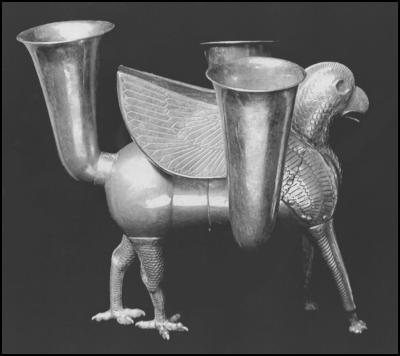
Experts are calling it a fake. I am not an expert on this particular country, but compared to what I have seen I would be inclined to agree. The hindquarters do not look right to me. You can read all about it here. It is telling that this article did not appear in a media outlet in the United States.
This artifact made the news recently.
Experts are calling it a fake. I am not an expert on this particular country, but compared to what I have seen I would be inclined to agree. The hindquarters do not look right to me. You can read all about it here. It is telling that this article did not appear in a media outlet in the United States.
Today's Maxwell Quote
From Wherefore, Ye Must Press Forward (1977), 27-28:
So many prospective disciples of Jesus spend their lives in this middle world, confused about which camp they belong to and which cadence they are to march to. It takes real integrity to see this middle world clearly, and the new disciple must not pause in it lest he become confused and remain in that realm.
Tuesday, October 8, 2013
Onchsheshonqy 8/4-5
Do not do something you have not first researched. Researching it is your good fortune. (P. Onch. 8/4-5)The demotic term šn basically means to ask and thus to inquire, investigate. It is used in the sense of a inquiry or investigation into criminal acts. In a scholarly sense it would include to research. It is also used for inquiring of god for an oracle, which might be through a vessel (e.g. P. Mag. 21/1) or a lamp (e.g. P. Mag. 6/1). The noun form is also used for the result of such an inquiry, i.e., a report, or news.
This is similar to the saying of Jesus recorded in Luke:
28 For which of you, intending to build a tower, sitteth not down first, and counteth the cost, whether he have sufficient to finish it?Estimating whether it is possible to accomplish something before beginning is generally a sound practice. Failure to properly do your research ahead of time often reveals hidden costs which should have been counted but were not.
29 Lest haply, after he hath laid the foundation, and is not able to finish it, all that behold it begin to mock him,
30 Saying, This man began to build, and was not able to finish.
31 Or what king, going to make war against another king, sitteth not down first, and consulteth whether he be able with ten thousand to meet him that cometh against him with twenty thousand?
32 Or else, while the other is yet a great way off, he sendeth an ambassage, and desireth conditions of peace. (Luke 14:28–32)
Today's Maxwell Quote
From The Smallest Part (1973), 21-22:
Precisely because of the force of his conscience, the Christian knows the adversary is "jamming" the signals from conscience, hoping we will drift into "mainstream" and away from the "strait and narrow" course. Satan also sends out his own signals and seeks to put an unchaste society on guard against prudery; to warn a relatively idle people about being overworked and exploited; to alert a permissive society concerning the dangers of authority precisely as that society is rushing headlong into anarchy; to prod alienated souls (who hunger for belonging and the sense of being useful and needed) to abandon the family and to avoid parenthood; to induce those wishing to be more "free" to build around themselves higher and higher walls of sensuality; and to tout "honest" books, movies, and dramas, but to avoid being honest with themselves.
Monday, October 7, 2013
Katuwas, Son of Suhis
Even most specialists of the ancient Near East have probably not heard of Katuwas, son of Suhis. He was the ruler of Carchemish about the end of the tenth century BC. Katuwas was one of the rare rulers of the ancient world to admit to defeats and setbacks in an official inscription, this one on the city gates no less. He begins his inscription with a short genealogy noting that his father was Suhis and his grandfather Astuwalamanzas. He emphasizes his justice, but then notes:
Katuwas was a Neo-Hittite ruler. As the Hittite rulers before him, he learned that greedy relatives (or subordinates) are only too happy to usurp power and wealth. Fortunately, he also knew how to count his blessings.
But my relatives(?) revolted against me, and therefore they caused the lands to break away from under me. (Karkamish A11a, translation from Annick Payne, Iron Age Hieroglyphic Luwian Inscriptrions [Atlanta: Society of Biblical Literature, 2012], 68.)Katuwas then states that in spite of the loss of the lands and revenue, he was blessed that the lands still under his control were able to bring in surpluses so that he could build a temple.
Katuwas was a Neo-Hittite ruler. As the Hittite rulers before him, he learned that greedy relatives (or subordinates) are only too happy to usurp power and wealth. Fortunately, he also knew how to count his blessings.
Today's Maxwell Quote
From The Smallest Part (1973), 10:
One would think it folly, for instance, if Holland spent a significant portion of its citizens' time and money destroying the dikes that hold back the sea; it would seem even more absurd if the Dutch people stood by cheering the wrecking crews! Yet, so much of what we are doing currently in our own culture is the equivalent of breaching the dikes, of removing tried and proven safeguards.
Sunday, October 6, 2013
General Conference
Today is the second day of General Conference. Please pay attention to the proceedings.
Today's Maxwell Quote
From Wherefore, Ye Must Press Forward (1977), 26-27:
There is so much that the Church stands for that will, more and more, be confronted by and coexist with evil—cheek by jowl, wheat by tares—until the end comes. Our time will become a calendar of contrasts in which the forces of evil will not only attack righteousness, but will do so with an ersatz enthusiasm and plastic nobility as they do the devil's work. By relentless pressure the adversary will seek to pull all he can into his "outer darkness" forever. It is so like him to direct our attention away from our gravest dangers. Can't you just about hear the preachments against prudery in Sodom and Gomorrah?
Saturday, October 5, 2013
Today's Maxwell Quote
From One More Strain of Praise (1999), 69:
One important way, therefore, in which the Church is to be "independent" involves distancing ourselves from the philosophies and persuasions of men, and from the encompassing and enveloping ways of secular societies (D&C 78:14). Secularism recruits so easily, because so many mortals "will not endure sound doctrine," but come to prefer the easier and more fashionable "commandments of men" (2 Tim. 4:3). But, of course, the fashions of the world will pass away. (See Matt. 15:9.) It will be interesting to see, for instance, how long America can sustain an inspired and constraining Constitution, if more of the people it governs become persistently permissive. Will what is now the "lesser part" reach a critical, negative mass? (See Mosiah 29.)
Friday, October 4, 2013
Dolls and Idols
A couple of decades back I attended a lecture by Raphael Patai on Israelite figurines. Patai argued that female figurines found on excavations in Israel were representations of the goddess Asherah, whom he identified as a female fertility goddess. He noted that the figurines were about ten inches high and made of clay. None of the figurines were labeled.
After the presentation, I asked why these figurines might not be dolls. He replied that the figurines had exaggerated sexual characteristics and that Barbie dolls did not have exaggerated sexual characteristics. At that point all the women in the room burst out laughing.
I did not ask the question to make fun of Professor Patai, whom I greatly respect. I simply wanted to hear a good argument about an alternate hypothesis. I still would.
William Dever makes the same argument that the figurines represent the goddess Asherah in his book Did God Have a Wife? (Grand Rapids, Michigan: Wm. B. Eerdmanns, 2005).
In discussing the archaeological context of the figurines, Dever says,
Unfortunately, Dever provides some evidence that undermines his argument.
Dever notes that the figurines are found
If the figurines were Asherah images we should expect them in the context where we usually do not find them and not in the contexts where we do.
So the question remains: Why can't these figurines be dolls?
After the presentation, I asked why these figurines might not be dolls. He replied that the figurines had exaggerated sexual characteristics and that Barbie dolls did not have exaggerated sexual characteristics. At that point all the women in the room burst out laughing.
I did not ask the question to make fun of Professor Patai, whom I greatly respect. I simply wanted to hear a good argument about an alternate hypothesis. I still would.
William Dever makes the same argument that the figurines represent the goddess Asherah in his book Did God Have a Wife? (Grand Rapids, Michigan: Wm. B. Eerdmanns, 2005).
In discussing the archaeological context of the figurines, Dever says,
there is no obvious "pattern" of distribution that would help to specify just what these figurines signified or exactly how they were used. They were certainly not "toys" (below). (p. 181)So Dever has promised to argue why these female figurines were not toys. A bit later in the book he fulfills his promise after a fashion. His argument is:
A few even go to the absurd extreme of declaring that the figurines are merely toys --- which I call the "Barbie-doll syndrome" (p. 188).As effective as this mockery may be rhetorically, it is not an argument. It does not state why these figurines need to be figures of Asherah and not dolls.
Unfortunately, Dever provides some evidence that undermines his argument.
Dever notes that the figurines are found
in all sorts of contexts, nearly all domestic: in houses; in cisterns, pits, and rubbish heaps; and in debris of all kinds. But they are relatively rare in tomb deposits, as well as in clear cultic contexts (p. 180).He continues:
context is fundamental to determining the meaning of archaeological artifacts, so we are led to conclude that the female figurines have more to do with household than with community cults, more with ongoing life events than with death and funerary rituals (pp. 180-81).All of this fits nicely with the view that these figurines are dolls rather than idols. The Hebrew Bible mentions Asherah several times, and usually in the context of a cultic installation (e.g. Exodus 34:13; Deuteronomy 7:5; 12:3; 16:21; Judges 6:25-30; 1 Kings 14:23; 16:32-33; 18:19; 2 Kings 17:10, 16; 18:4; 21:3, 7; 23:4, 6-7, 14-15; Isaiah 17:8; 27:9; Jeremiah 17:2).
If the figurines were Asherah images we should expect them in the context where we usually do not find them and not in the contexts where we do.
So the question remains: Why can't these figurines be dolls?
Today's Maxwell Quote
From One More Strain of Praise (1999), 63:
Mercy, even so, is not naiveté. Nor is it uncaring indulgence. Nor is mercy to be mistaken for today's standardless and indulgent tolerance. Divine mercy has its fixed divine standards intact. When Jesus said, "Father, forgive them; for they know not what they do," He was mercifully and forgivingly acknowledging what was, nevertheless, an ignorantly induced but terrible wrong! (Luke 23:34.)
Thursday, October 3, 2013
On Egyptian Apocalyptic Literature
Recently there has been an increase in interest in Egyptian apocalyptic literature. The Egyptian apocalyptic literature "creates the picture of the evil into which Egypt has fallen" (Roberto B. Gozzoli, The Writing of History in Ancient Egypt during the First Millennium BC (ca. 1070-180 BC) (London: Golden House Publications, 2006), 301.) In Roberto Gozzoli's treatment of the subject, he notes the following features of the genre:
Glorification of pharaohs immediately preceeding a foreign invasion, or fighting against an invader.
Demonisation of any foreign invasion.
The pharaoh's return
The glorious warrior of the past. (Gozzoli, The Writing of History in Ancient Egypt, 302-304.)He observes that
it was unbelieveable for the ancient Egyptians to accept that their country might have been occupied by foreigners, unless the political situration in Egypt was weakened by some misconduct of a bad pharaoh. (Gozzoli, The Writing of History in Ancient Egypt, 303.Yet for all its emphasis on the rottenness of the situation in Egypt, Egyptian apocalyptic literature is not necessarily dreary:
The destruction of a country and in this particular case, Egypt, is never an end, but only a representation of a fallen reality which will be some day restored to the pristine glory, once the original conditions of religious respect will be reinstated. (Roberto B. Gozzoli, The Writing of History in Ancient Egypt, 304.)In that sense, apocalyptic literature could actually be described as hopeful.
Today's Maxwell Quote
From That My Family Should Partake (1974), 83-84:
Access to the Spirit can also give us the extra wisdom in tactical situations where we might otherwise be swept along with the herd. Just because some among us today are pleading and cajoling for more and more freedom to drive themselves mad, those who do not wish to join any such march of the lemmings should not have to. But that happy decision to resist being steered along with the herd will need constant reinforcement, and the Spirit can give such to each of us.
Wednesday, October 2, 2013
The Disappearance of the Chaldeans
From time to time it is worth taking stock of how we know what we know, or what we think we know. Sometimes certain obvious facts need to be pointed out lest we take them for granted, or worse, assume they are not true.
An example of this is the Chaldean origin of the Neo-Babylonian Empire. It is generally assumed that the Nebuchadnezzar, who sacked Jerusalem and took the Jews captive into Babylon, was part of a dynasty that was Chaldean in origin. Thus the Jews were captive in Babylon, in Chaldea, and the Chaldeans were another name for the Babylonians. That may not be the case though. As Paul-Alain Beaulieu points out in a recent article:
This has some implications for those who would argue that Abraham's Ur of the Chaldees was located in southern Babylon based on the fact that the Neo-Babylonians thought of themselves as Chaldeans. As far as we know, they didn't.
An example of this is the Chaldean origin of the Neo-Babylonian Empire. It is generally assumed that the Nebuchadnezzar, who sacked Jerusalem and took the Jews captive into Babylon, was part of a dynasty that was Chaldean in origin. Thus the Jews were captive in Babylon, in Chaldea, and the Chaldeans were another name for the Babylonians. That may not be the case though. As Paul-Alain Beaulieu points out in a recent article:
Not only do we find no ancient claim for the Chaldean origin of the dynasty, but the term Chaldean does not appear even once in late Babylonian cuneiform documentation. (Paul-Alain Beaulieu, "Arameans, Chaldeans, and Arabs in Cuneiform Sources," in Arameans, Chaldeans, and Arabs in Babylonia and Palestine in the First Millennium B.C., ed. Angelika Berlejung and Michael P. Streck [Wiesbaden: Harrassowitz, 2013], 33.)Beaulieu points out that there are over 60,000 late Babylonian sources (ibid., 31). The Chaldeans did exist; they appear in Neo-Assyrian sources. Apparently, in Neo-Babylonian times, though, they no longer thought of themselves as Chaldeans. Another alternative is that Chaldeans may have always been an outsider designation (by Assyrians, Jews, Greeks, Romans).
This has some implications for those who would argue that Abraham's Ur of the Chaldees was located in southern Babylon based on the fact that the Neo-Babylonians thought of themselves as Chaldeans. As far as we know, they didn't.
Today's Maxwell Quote
From One More Strain of Praise (1999), 9-10:
Praise be to God, because the gospel permits us to see even more clearly "things as they really are, and . . . things as they really will be" (Jacob 4:13). If things are not seen with such gospel clarity, so many mortal lives end up being consumed by such puny purposes. Otherwise, too, without gospel perspectives human capacity can be so under-employed and improperly focused that it is like using the huge telescope on Mt. Palomar merely to study nearby Catalina Island. The grand Restoration is not only a crucial and needed restitution of "plain and precious things" but it is also a refutation of various prevailing and incorrect views of life, including the view that life is merely a meaningless brevity.
Tuesday, October 1, 2013
Kudos
Kudos to my friend and colleague, Matt Roper, whose work, originally published here and then corss-posted here, was cited by Elder D. Todd Christofferson at a devotional at BYU-Idaho last week.
Roper is a very good scholar of the Book of Mormon. I am not surprised that his scholarship is worth looking at but am pleased that someone else thinks so.
Roper is a very good scholar of the Book of Mormon. I am not surprised that his scholarship is worth looking at but am pleased that someone else thinks so.
Today's Maxwell Quote
From That My Family Should Partake (1974), 102:
As Wendell Johnson has warned, “. . . nothing fails like failure. . . . The tears which it produces water the soil from which it grows ever more luxuriantly.” (People in Quandries, New York: Harper Brothers, 1946, p. 12.) Some of us are simply too busy irrigating!
Monday, September 30, 2013
Reasons to Look to the Past
Two recent articles highlight how old-fashioned teaching can produce superior results.
In one, Joanne Lipman reflects on how her high school orchestra teacher's methods, which would get him fired today, helped shape his student's successful careers, mostly outside of music. She argues that students need unsentimental honest feedback, memorization, failure. She notes that "strict is better than nice," and "grit trumps talent."
In the other, Peter Lawler reflects on Lipman's article. He talks a bit about the problems of playing up self-esteem:
Real self-esteem--pride as opposed to vanity--comes from pleasurable reflection on real accomplishments, on meeting real challenges, on magnanimously or generously displaying one’s personal greatness. So the best teachers are stingy with praise in order that it really mean something.Lawler also discusses the problem of trying to teach critical thinking devoid of content:
They know that “critical thinking” or “problem solving” can’t be divorced from the content of who we are and what we do.Both pieces are thoughtful reflections of the process of learning.
Today's Maxwell Quote
From That My Family Should Partake (1974), 88:
God has reminded us that it is possible for men to love darkness rather than light. One has to assume that those who do evil hate the light not only because it exposes them, but because they have grown grumblingly used to the darkness.
Sunday, September 29, 2013
John and Jonathan
There are many people who think that John is a shortened form of Jonathan. If that were the case, one might wonder why Mattathias, the father of the Maccabees, had children named both John and Jonathan (1 Maccabees 2:2-5).
John comes from Hebrew Yohhannan and means "Jehovah is merciful." Jonathan comes from Hebrew Yohnatan and means "Jehovah has given (a son)." They are not the same name and were not interchangeable.
John comes from Hebrew Yohhannan and means "Jehovah is merciful." Jonathan comes from Hebrew Yohnatan and means "Jehovah has given (a son)." They are not the same name and were not interchangeable.
Today's Maxwell Quote
From One More Strain of Praise (1999), 34-35:
The satisfying of the requirements of divine justice by means of Jesus' great atonement is central to the Father's plan of salvation, a plan which clearly reflects and is sustained by Jesus' character and atonement, an atonement made possible by Jesus' character. In this happy and merciful situation, the Lord can forgive our sins, yet He "cannot look upon sin with the least degree of allowance," hence the unclean and unrepentant, though resurrected, will not be exalted (Alma 45:16; D&C 1:31).
Now the work of justice could not be destroyed; if so, God would cease to be God.
And thus we see that all mankind were fallen, and they were in the grasp of justice; yea, the justice of God, which consigned them forever to be cut off from his presence. . . .
What, do ye suppose that mercy can rob justice? I say unto you, Nay; not one whit. If so, God would cease to be God. (Alma 42:13-14, 25; see also D&C 88:40.)
Even divine mercy cannot rob justice! Such, therefore, is the very basic need to satisfy the requirements of divine justice, which are "affixed," and thus "answer the ends of the atonement" (2 Ne. 2:10).
In God's plan of happiness the atoning Christ paid a debt He personally did not owe and at a costly price that we could not possibly pay by ourselves. Unlike the Father's plan, in today's context of indulgent secularism, however, too many insist that mercy "rob justice," and much more than "one whit." C. S. Lewis saw the modern trend coming well before it became more fully blown:
The Humanitarian theory wants simply to abolish Justice and substitute Mercy for it. . . . Mercy, detached from Justice, grows unmerciful. That is the important paradox. As there are plants which flourish only in mountain soil, so it appears that Mercy will flower only when it grows in the crannies of the rock of Justice: transplanted to the marshlands of mere Humanitarianism, it becomes a man-eating weed, all the more dangerous because it is still called by the same name as the mountain variety. ("The Humanitarian Theory of Punishment" [1949], in God in the Dock: Essays on Theology and Ethics, ed. Walter Hooper [Grand Rapids, Mich.: Eerdmans, 1970], p. 294.)
Saturday, September 28, 2013
On the Attack on Religious Liberty
William McGurn has a worthwhile reminder of the importance of religious liberty and the challenges it faces now. These issues not only need to be understood, they need to be acted upon.
Today's Maxwell Quote
From That My Family Should Partake (1974), 115-116:
When we recognize that what we are really engaged in in this instance is war against evil, the more important the simple strategies are, like occupying and holding high ground, and refusing to go into the swamps simply to see if we could survive. There are simply too many bleached bones lying about the landscape as haunting reminders of the importance of fleeing from the terrain of temptation. Sometimes circumstances may cast up an unavoidable encounter with things we would rather not brush against, but in each of these we have been promised by the Lord that even then he will make an escape passage for us.
Friday, September 27, 2013
The Juxtiposition of Two Quotes
Every so often one runs into a quote that makes one think, "I've heard this before." Here is one such, from an article on black-balling in sociology:
Rather than embracing libertarian values that could strengthen the discipline, the self-appointed mind-guards systematically frustrate any attempt to vary the narrative that sociology has developed. By keeping dissent from the classroom, good ideas are censored and good students are kept out of the major. The inclusiveness that is valued extends only to those who do not deviate from the orthodoxy.The quote it reminded me of is this one, from this talk:
Irreligion as the state religion would be the worst of all combinations. Its orthodoxy would be insistent and its inquisitors inevitable. Its paid ministry would be numerous beyond belief. Its Caesars would be insufferably condescending. Its majorities—when faced with clear alternatives—will make the Barabbas choice, as did a mob centuries ago when Pilate confronted them with the need to decide.Sociology does not need to be irreligion, but one can see what irreligion as the state religion would be like by looking at the sociology, or elsewhere in the academy, since such squelching of dissent is not confined to sociology. Ironically it seems to be particularly prevalent among those preaching tolerance.
Today's Maxwell Quote
From That My Family Should Partake (1974), 39-40:
Those who are grossly selfish are also the same people who, cavalierly, use ends to justify means. For the grossly selfish, once an object or desire has been fastened on, it is very easy for the selfish person to ignore the harm and injury done to others (and to institutions) when he reaches for that object.
Thursday, September 26, 2013
A Step in the Right Direction?
Audrey Williams June has a nice article on the placement rates of Ph.D. programs. She notes that some graduate programs do not collect data on graduate placement or other vital information that might be helpful to students going into graduate school.
Since I have had to advise prospective graduate students in Egyptology, much of this data is data that have wanted to get my hands on for various programs. These include:
Other relevant data for prospective graduate students to consider includes:
Since I have had to advise prospective graduate students in Egyptology, much of this data is data that have wanted to get my hands on for various programs. These include:
- How many graduate students does the program accept on any given year?
- What are the minimum and average scores for candidates admitted over the last ten years?
- What does the faculty in that particular graduate program look for in their graduate students?
- What percentage of admitted students in the last decade actually finish their programs?
- How long, on average, has it taken for graduate students who have finished in the last ten years to finish their degrees?
- How many graduates in the last ten years have jobs in the field?
- How many years did it take for a graduate to get a tenure-track job?
- Why do admitted students leave the program?
- What are the completion rates of various advisers in the program?
- What are the placement rates of various advisers in the program?
Other relevant data for prospective graduate students to consider includes:
- How much is tuition at the school in question?
- What is the average annual percentage tuition increase over the last ten years?
- How much are the other fees at the school?
- What is the average cost of living in the area?
- What is the crime rate in the area?
Today's Maxwell Quote
From That My Family Should Partake (1974), 32-33:
No one who understands the purposes of God can, therefore, refuse to take his own responsibility for a portion of history. In such a context, little wonder that the doctrines and teachings of God matter so much. It is most unfortunate that in the surge toward secularism those who have ignored the teachings of God about the purpose of life and this planet have been so heedless; the Christian's response involves more than merely replacing the doctrinal divots on the fairway that the secularists have torn up. Even worse, as secularism has pushed out Christian thought, it has developed its own powerful dogmas it defends and, in a sense, "has turned against its own basic ideal of truth-seeking." In this regard, secularism is increasingly orthodox and is very harsh on heretics.
Wednesday, September 25, 2013
Charity and Grade Inflation
In this article, George Leef makes a number of cogent arguments about how contributing to grade inflation harms not only those grades are inflated but also those whose grades are not inflated.
There is another way to think about this. Giving students inflated grades is a way of puffing them up. Since "charity vaunteth not itself, is not puffed up" (1 Corinthians 13:4), are we showing charity by puffing other people up?
There is another way to think about this. Giving students inflated grades is a way of puffing them up. Since "charity vaunteth not itself, is not puffed up" (1 Corinthians 13:4), are we showing charity by puffing other people up?
Today's Maxwell Quote
From That My Family Should Partake (1974), 33:
The king in the Book of Mormon who was deeply impressed with the generosity shown by Ammon knew that he had experienced someone who was special. This generosity can only exist in the context of selflessness. Just as fire requires oxygen, so generosity and mutuality require significant selflessness. We are accustomed to reading about the challenges of spiraling violence and spiraling inflation, and these are very real; but spiraling selfishness is at the very center of all the other spiraling challenges of today.
Tuesday, September 24, 2013
Ranking Fourth
BYU has placed fourth in the rankings of the top ten most high-strung schools. This ranking comes ultimately from College Magazine. Their reasoning for this ranking is:
Brigham Young is high-strung because of its straight-edge nature. Its strict honor code, modest form of dress and rules against drug and alcohol only add to the stress.But that is not the worst:
Not only can you not find drugs or alcohol, but you also can’t even buy caffeine on campus.(They forgot to mention that beards are against the honor code too.) If BYU's honor code is a cause of stress, more colleges should be stressed out.
Today's Maxwell Quote
From Lord, Increase Our Faith (1994), 69:
In 1829, especially while translating at an average rate that would produce seven to ten printed pages a day, Joseph would not have fully or immediately comprehended all the powerful and enhancing verses that were passing through him. One example of these is Alma 7:11-12, which represents a powerful addition to our understanding of Jesus' suffering and of His atonement and how it is that His empathy for each of us is perfect and very personal. Jesus understands the full range of human suffering. These and other insights were beyond Joseph Smith in 1829.
Monday, September 23, 2013
Early Christian New Testament Reading
What sort of New Testament books were the most popular in Early Christianity. I will look at two time periods using two different methods of analysis. For the early second century, we have quotations in Church Fathers. For the third and fourth centuries, we can look at attestations of various books when they circulated as separate books and not as complete New Testament codices.
For the second century we have, in order of popularity:
For the second century we have, in order of popularity:
- Matthew (32)
- 1 Corinthians (16)
- 1 Peter (13)
- Romans (8)
- Luke (6)
- Acts (4)
- Galatians (4)
- 1 Timothy (4)
- Hebrews (4)
- John (3)
- Ephesians (3)
- Philippians (3)
- Titus (3)
- Mark (1)
- 2 Corinthians (1)
- 1 Thessalonians (1)
- 2 Thessalonians (1)
- 2 Timothy (1)
- 1 John (1)
- 2 John (1)
- Revelation (1)
- Matthew (17)
- John (16)
- Acts (7)
- Luke (6)
- Hebrews (6)
- Romans (5)
- Revelation (5)
- Ephesians (3)
- 1 Thessalonians (3)
- James (3)
- Mark (2)
- 1 Corinthians (2)
- 2 Corinthians (2)
- Philippians (2)
- 2 Thessalonians (2)
- 1 Peter (2)
- Jude (2)
- Galatians (1)
- Colossians (1)
- Titus (1)
- Philemon (1)
- 2 Peter (1)
- 1 John (1)
Today's Maxwell Quote
From We Will Prove Them Herewith (1982), 82:
The early universities (Paris, Bologna, Oxford, Cambridge, and Harvard) had Christian religion at their core. The University of Paris, for instance, stood at the heart of the spiritual life of its age, but such universities, wrote Richard Hofstadter,
"were scarcely less important as agencies of practical life, whose work was as relevant to the ecclesiastical and political life of the thirteenth and fourteenth centuries as the modern university is to the scientific and industrial life of our time."The 1650 charter for Harvard College spoke of "the advancement of all good literature, artes and Sciences," "in knowledge: and godliness."
Edward Reynolds, a Puritan author, correctly observed:
All truth must by definition come from God, and all knowledge of truth be ultimately knowledge of Him; but we must recognize that "there is a knowledge of God natural in and by his works and a knowledge supernatural by revelation out of the Word; and though this be the principal, yet the other is not to be under-valued."Reynolds also wrote affirmatively of such education and how "Sanctified Wit beautifies Religion, sanctified Reason defends it, sanctified power protects it, sanctified Elocution perswades others to the love of it."
Many once church-related institutions, however, have long since become indistinguishable from other universities and colleges, keeping the ceremonial robes without the theology, the pomp without the purpose.
Sunday, September 22, 2013
Early Christian Scripture Reading
Judging by what they quote, the earliest writers of the Christian church after the New Testament really liked the following books of scripture:
- Genesis
- Exodus
- Psalms
- Isaiah
- Matthew
- 1 Corinthians
Today's Maxwell Quote
From All These Things Shall Give Thee Experience (1980), 119:
Yet we must always realize that in a perfect church filled with imperfect people, there are bound to be some miscommunications at times. A noteworthy example occurred in ancient American Israel. Moroni wrote two times to Pahoran complaining of neglect because much-needed reinforcements did not arrive. Moroni used harsh language, accusing the governor of the land, Pahoran, of sitting on his throne in a state of "thoughtless stupor." (Alma 60:7.) Pahoran soon made a very patriotic reply, explaining why he could not do what Moroni wanted. Though censured, Pahoran was not angry; he even praised Moroni for "the greatness of your heart." (Alma 61:9.) Given the intense, mutual devotion of disciples, discussions as to how best to move the Lord's work along are bound to produce tactical differences on occasion. Just as in this episode, sometimes scolding occurs that is later shown to be unjustified.
Saturday, September 21, 2013
Sacred and Secular Histories
The third chapter of John Sorenson's new book, Mormon's Codex provides a completely secular view of Nephite history. This is not the first time such a thing has been done. One can look at contributions by John Sorenson and John Welch in the book Warfare in the Book of Mormon and they do the same thing.
This is a remarkable thing as both Sorenson and Welch are believers, not secularists. Secularists do not write secular histories of Nephite civilization, only believers do. On one level this seems counter-intuitive; on another level, perfectly obvious.
It seems counter-intuitive because ancient histories in general are deeply religious. Thus secularists routinely write secular histories of ancient societies that strip away the religious element of ancient histories. Egyptologists routinely write about Egyptian history and discuss such things as Sesostris I raiding Nubia without saying that Osiris commanded it. Assyriologists also write about the conquests of the Sargonid kings without noting that they claimed to conquer by the command of Assur.
The Book of Mormon is different. One has to be a believer in the first place to consider it ancient history. Only when one considers it real history can one write a secular history of the civilization.
One does not have to be a believer to talk about Book of Mormon theology, in fact it is usually easier to talk about Book of Mormon theology when one is not a believer. Theology is a systematic ordering and attempt to derive knowledge of divine things by human reason alone. Believers tend to think that knowledge of divine things need to come by revelation. Originally, theology was lies told about God to manipulate simpletons for political ends. Believers do not engage in such actions but non-believers do.
So non-believers will find it easy to produce Book of Mormon theology, but only a believer will produce Book of Mormon history.
Today's Maxwell Quote
From this talk:
Isn't it ironical that some of those who are most vigorous in taking the American family apart are also among those who are the first to complain because, then, the family does not work? Isn't it ironical that in an age when we are learning almost feverishly about what is most ecologically sound, what are the most efficient and economic ways to produce energy or protein in order to help other human beings, that we should be so incredibly blind—because like ancient Judah, we are "looking beyond the mark"—when it comes to pursuing those processes which are best for the production of good human beings? The relative spiritual, as well as the physiological efficiencies of systems are a justifiable concern. Beef cattle foraging on a poor range require twenty pounds of food in order to produce one pound of gain. Chickens with a good balanced diet produce one pound of gain for every two pounds of feed. One approach is many times more efficient than the other, just as (so far as human goodness is concerned) the social and spiritual sum of our political, educational, and economic institutions is usually not sufficient to offset the deficits in the home.
Friday, September 20, 2013
Words and Deeds
Since there is little point in merely complaining about something that you can actually do something about, I have compiled a scriptural index to John Sorenson's Mormon's Codex and posted it over on Ether's Cave.
Today's Maxwell Quote
From For the Power Is in Them (1970), 32:
Just as trust and love between individuals frees us to listen, human nature also makes it easier to listen to the "critic" who really loves that which he criticizes. My experience in the Church is that the devoted, committed member is listened to (he may not find his counsel followed, of course) because his caring (which underlines his complaint) manifests itself in specific ways which remove any doubts about his devotion.Hugh Nibley was like that. Many would listen to his sometimes blistering criticism of certain practices of Church members because no one had any doubt about his commitment to the Gospel or the Church. His criticisms were about Church members not actually following the Gospel.
Thursday, September 19, 2013
Is This a Coincidence?
Looking through P. Mil. Vogl. III today, I noticed a series of demotic contracts from Ptolemaic Egypt where various women appear to be selling themselves into slavery. In every single case the name of the woman's father is listed as "I don't know."
In modern times there is a clear connection between a lack of fathers and poverty. Is this ancient evidence for that same phenomenon?
In modern times there is a clear connection between a lack of fathers and poverty. Is this ancient evidence for that same phenomenon?
Today's Maxwell Quote
From For the Power Is in Them (1970), 8:
It is clear that even when we let our light shine without ostenation and with no thought of doing deeds "to be seen of men," there still can arise situations in which our example—per se—goads others. Nephi's righteousness and his father's frequent citations of Nephi's spiritual superiority to his older brothers did not go down well with Laman or Lemuel, (and Lemuel was clearly Laman's unwavering psychological satellite. See 1 Nephi 3:28.)
That others may be so offended is not reason for us to reduce such righteousness as we have.
Wednesday, September 18, 2013
On History and Records
K. A. Kitchen notes:
We do not actually need firsthand namings of the patriarchs in ancient records; plenty of other historical characters are in the same case. The tombs of Early, Middle, and Late Bronze Canaan have yielded countless bodies of nameless citizens of Canaan; but their anonymity (no texts!) does not render them nonexistent. (K. A. Kitchen, On the Reliability of the Old Testament [Grand Rapids, Michigan: William B. Eerdmans, 2003], 372.)Whether events were written down they still happened. We, as mortals, are still accountable for our acts whether or not anyone wrote down a record.
Today's Maxwell Quote
From Wherefore, Ye Must Press Forward (1977), xi:
Whether one is newly baptized, reactivated, or already about his Father's business, he faces two challenges: remaining true to the decisions and covenants that have brought him thus far into serious discipleship, and then, both progressing and enduring in his discipleship.
Tuesday, September 17, 2013
A Flaw in Mormon's Codex
I regret to announce a flaw in John Sorenson's new book, Mormon's Codex.
This flaw is not Sorenson's fault. I do not blame him for it.
The flaw is that the book has no scriptural index. It needs one. Any 800 page book carefully analyzing passages from another work needs one.
This flaw is not Sorenson's fault. I do not blame him for it.
The flaw is that the book has no scriptural index. It needs one. Any 800 page book carefully analyzing passages from another work needs one.
Today's Maxwell Quote
From Wherefore, Ye Must Press Forward (1977), 9:
Among the hard realities about societies is the reality that liberty, if it is abused too much, will destroy itself. A society that continually permits anything will lose everything. To be sure, drawing lines is admittedly difficult, but once society shrinks from drawing any behavioral lines simply because to do so is difficult, it has surrendered. To confuse tolerance with permissiveness can be fatal, since it is like not knowing the difference between a mushroom and a poisonous toadstool.
Monday, September 16, 2013
The Abomination of Desolation
The English phrase "abomination of desolation" comes from the King James translation of Matthew 24:15. The Greek phrase is τὸ βδέλυγμα τῆς ἐρημώσεως. As Jesus says, it appears in Daniel 9:27 and Daniel 11: 31. It also appears in 1 Maccabees 1:54.
Daniel 9:27 uses the concept after mentioning that it will occur after the Messiah is cut off (yikkaret; Daniel 9:26).
Daniel 11:31 says that it will come after the sanctuary of the temple is polluted and the daily sacrifice is taken away.
The mention in 1 Maccabees 1:54 is perhaps more interesting because the use of the phrase is not a prophecy but rather in a historical text. The situation described is clearly depicted as a fulfillment of the prophecy in Daniel. (Jesus projects it as still in the future.) Prefaced to this use is a description of the actions of Antiochus IV Epiphanes.
Antiochus wanted a unified populous (1 Maccabees 1:41) and wanted his empire to go in a new direction, therefore he commanded "each to abandon his customs" (1 Maccabees 1:42). As a consequence, "many from Israel were happy to serve him and they sacrificed to idols and violated the Sabbath" (1 Maccabees 1:43) and "to follow the customs of the heathen" (1 Maccabees 1:44). They stopped the sacrifices (1 Maccabees 1:45), and "polluted the holy things" (1 Maccabees 1:46). They built altars to idols (1 Maccabees 1:47), "so that they forgot the law and changed all the judgments and whosoever would not do according to the command of the king was put to death" (1 Maccabees 1:49-50). Furthermore, they set up overseers (ἐπισκόπους, "bishops" although "spies" might be a better translation in the context) to insure that everyone followed the new way of thinking. "Everyone who abandoned the law and did evil in the earth" was promoted into positions of responsibility (1 Maccabees 1:52). And then, "on the fifteenth of Chaseleu, in the one hundred and forty-fifth year, an abomination of desolation (βδέλυγμα ἐρημώσεως) was established at the altar" (1 Maccabees 1:54).
This passage shows the processes that led the authors of 1 Maccabees to decide that the prophecy of Daniel had been fulfilled. Polluting the sanctuary and cutting off the daily sacrifices are both mentioned to draw the reader's attention that the conditions had been met. But following the Gentile customs and doing things their way. Covenants and the law were both abandoned. Spies were put in place to report and insure that everyone behaved the way that the new regime wanted them to. And "they burned the books of the law which they found" (1 Maccabees 1:56). It was, after all, important to rewrite the history and make the previous orthodoxy disappear.
This description from Maccabees supplies an understanding of what Jesus was predicting for the future of Christianity before his death.
Today's Maxwell Quote
From this talk:
A little experience with federal and state bureaucracies has taught me that such bureaucracies are inhabited by basically good civil servants, onto whom voters have pushed too much power for their good or ours. What we unwittingly court in such circumstances is learning again, painfully, that "almost all" men can't handle authority without abusing it. Whether or not the American people, regardless of party, can tame their governments is yet to be determined, but sunset laws alone will not do it. If citizen appetites, once aroused, merely look to a new agency to do what a disestablished agency once did, it won't be enough. Addicts can always find new pushers.
Sunday, September 15, 2013
Matthew 24:13
After listing the various bad things that will happen, Jesus says:
ὁ δὲ ὑπομείνας εἰς τέλος οὗτος σωθήσεται.It is the one who endures, or remains steadfast, to the end, through the suffering, the famines, the earthquakes, the plagues, the wars, the afflictions, the false prophets, the false Christs, the hatred, the persecutions, the betrayals, the assassinations, who will be saved. Jesus tells his followers that they can expect rather dreadful times and rather dreadful treatment. And yet, at the end they will be saved.
He who endures to the end, that one will be saved (Matthew 24:13).
Today's Maxwell Quote
From A Time to Choose (1972), 29:
God's power can only be controlled by the principles of righteousness. No mortal constitutions can safeguard access to secular power as firmly. God only shares his power with those who will not abuse it, nor use it to cover their sins, gratify their pride, ambition, or control other men.
Saturday, September 14, 2013
Sorenson on Geography
Not everyone agrees with John Sorenson on Book of Mormon geography. Some people would rather locate the Book of Mormon in the Mississippi valley, or in the Great Lakes area, or in Peru, or around the isthmus of Panama, or on the Baja Peninsula, or in Malaysia, or in any number of other places. Everyone should, however, agree with this point Sorenson makes on geography in his new book:
Heretofore the study of Book of Mormon geography has mainly consisted of making more or less random guesses as to one modern location or another where events portrayed in the Book of Mormon supposedly took place. For the most part such unsystematic studies have been undertaken after examining only some of the 600 references to geography found in the text. That is, a typical investigator peruses a map of the Americas, finds what he or she intuits to be a correlation, then proceeds to select from the Book of Mormon statements thought to support his correlation of choice. But a valid geography must do more than this. In order to have a realistic hope of establishing a real-world location for Book of Mormon events, one must reconcile everything the text say or implies about geography. (John L. Sorenson, Mormon's Codex [Salt Lake City: Deseret Book, 2013], 17.)
Today's Maxwell Quote
From But For a Small Moment (1986), 18:
Individuals and settings of obscurity are not unusual to the Lord's purposes. Meridian-day Christianity was initiated on a very small geographical scale and with comparatively few people. The larger, busy world paid little heed to it. Likewise with the Book of Mormon peoples. Whether located in Meso-America or elsewhere, they were one people among many peoples on this planet and perhaps even on the western hemisphere. Lack of knowledge of and communication with others was the factor here.
Friday, September 13, 2013
Real History and Fake History
Those who think the Bible was written in the Persian period (and, of course, a couple of works actually purport to have been written then, but those are not the work that those making the claim are talking about) or later in the Hellenistic period have not spent much time looking at actual documents from that time purporting to be earlier histories. There is a wealth of difference between apocryphal accounts of Israelite history and biblical accounts.
Consider the apocryphal versions of Israelite history in Judith or 1 Esdras. Esdras actually garbles Persian history, putting the kings in the wrong order. Judith garbles the capital of Babylon. 1 Kings and 2 Kings, on the other hand, get their Near Eastern history correct. If these accounts were written when the apocryphal accounts were, how did they manage to get things right when the apocryphal accounts get so much wrong?
Consider the apocryphal versions of Israelite history in Judith or 1 Esdras. Esdras actually garbles Persian history, putting the kings in the wrong order. Judith garbles the capital of Babylon. 1 Kings and 2 Kings, on the other hand, get their Near Eastern history correct. If these accounts were written when the apocryphal accounts were, how did they manage to get things right when the apocryphal accounts get so much wrong?
Today's Maxwell Quote
From this talk:
Patience is not indifference. Actually, it means caring very much but being willing, nevertheless, to submit to the Lord and to what the scriptures call the "process of time."
Thursday, September 12, 2013
A Sorenson Quote
John Sorenson is not a polemicist. But he has carefully and systematically sifted through immense amounts of material. Therefore, his careful assessment carries some weight with those who know him. I was thus intrigued by the following quote from his new book:
Critics have their own justifications for denying the historicity of the Book of Mormon, but rarely are their doubts based on reliable facts. (John Sorenson, Mormon's Codex [2013], 6.)
Today's Maxwell Quote
From Men and Women of Christ (1991), 27:
Reflection too is required in order to assimilate all of our on-rushing experiences. Unless the lessons from our past are humbly harvested, our storehouses of memory will contain too few relevant remembrances. Patience facilitates such pondering and reflecting. Pondering sorts things out, rearranging some of the furniture of the mind while giving place for new furnishings.
Wednesday, September 11, 2013
An Apology
Blogger has not been working correctly today.
We are having technical difficulties. Please stand by.
We are having technical difficulties. Please stand by.
Today's Maxwell Quote
From Men and Women of Christ (1991), 26:
A true disciple will not listen to the voices that deny the divinity of Jesus or of His latter-day work, that deny the apostolic foundations of the Restoration, or that suggest compromising with the world.
Tuesday, September 10, 2013
Matthew 24:12
So, continuing with the prophecy, what happens after all of the betrayal and hatred?
Betrayal certainly saps the love that might be extended as it is difficult to love someone who has stabbed one in the back.
Hatred, particularly open displays of it, does not foster love.
Deception, causing others to err because they have been given false information, also does not engender love.
In general, the spread of iniquity does not foster love. It reminds one of the tautology of the "hate crime." How often does one commit a crime against someone because they love them? The mere fact that someone was willing to commit a crime against someone is evidence that the perpetrator hates the victim. Someone who has been made a victim is usually not well-disposed to the perpetrator.
So, it really is not much of a surprise that iniquity does not foster love.
καὶ διὰ τὸ πληθυνθῆναι τὴν ἀνομίαν ψυγήσεται ἡ ἀγάπη τῶν πολλῶν.The increase in iniquity correlates directly with the freezing of love. The betrayal, hatred and deception all feed into the iniquity and to the lessening of love.
And because of the spread of iniquity, the love of many will grow cold (Matthew 24:12)
Betrayal certainly saps the love that might be extended as it is difficult to love someone who has stabbed one in the back.
Hatred, particularly open displays of it, does not foster love.
Deception, causing others to err because they have been given false information, also does not engender love.
In general, the spread of iniquity does not foster love. It reminds one of the tautology of the "hate crime." How often does one commit a crime against someone because they love them? The mere fact that someone was willing to commit a crime against someone is evidence that the perpetrator hates the victim. Someone who has been made a victim is usually not well-disposed to the perpetrator.
So, it really is not much of a surprise that iniquity does not foster love.
Today's Maxwell Quote
From this talk:
It may well be, as our time comes to "suffer shame for his name" (Acts 5:41), that some of this special stress will grow out of that portion of discipleship which involves citizenship. Remember that, as Nephi and Jacob said, we must learn to endure "the crosses of the world" (2 Nephi 9:18) and yet to despise "the shame of [it]" (Jacob 1:8). To go on clinging to the iron rod in spite of the mockery and scorn that flow at us from the multitudes in that great and spacious building seen by Father Lehi, which is the "pride of the world," is to disregard the shame of the world (1 Nephi 8:26–27, 33; 11:35–36). Parenthetically, why—really why—do the disbelievers who line that spacious building watch so intently what the believers are doing? Surely there must be other things for the scorners to do—unless, deep within their seeming disinterest, there is interest.
Monday, September 9, 2013
Matthew 24:11
Following the betrayals of Matthew 24:10, Jesus adds:
Earlier in Matthew, Jesus talks about false prophets:
καὶ πολλοὶ ψευδοπροφῆται ἐγερθήσονται καὶ πλανήσουσιν πολλούς·False Christs were mentioned earlier. False prophets would be individuals who claimed to speak for God but did so falsely. Many would be deceived by their claims. So the argument from popularity (i.e. that something is good because it is popular) is not necessarily a valid argument. These prophets also follow and supplant the disciples who are killed in the previous verse.
and many false prophets shall arise and shall deceive many (Matthew 24:11)
Earlier in Matthew, Jesus talks about false prophets:
Προσέχετε ἀπὸ τῶν ψευδοπροφητῶν, οἵτινες ἔρχονται πρὸς ὑμᾶς ἐν ἐνδύμασιν προβάτων, ἔσωθεν δέ εἰσιν λύκοι ἅρπαγες. ἀπὸ τῶν καρπῶν αὐτῶν ἐπιγνώσεσθε αὐτούς· μήτι συλλέγουσιν ἀπὸ ἀκανθῶν σταφυλὰς ἢ ἀπὸ τριβόλων σῦκα;This whole section follows from Jesus castigating the Pharisees because they said one thing and did something else. Those who do not bring forth good fruits are false prophets and do not speak for God. They should not be followed. Nevertheless, many will be deceived by them and follow them in spite of their never producing good fruits or good works.
Beware of false prophets, which come to you in sheep's clothing but inwardly are rapacious wolves. You will recognize them by their fruits: They did not gather grapes from thorns or figs from thistles. (Matthew 7:15–16)
Today's Maxwell Quote
From Meek and Lowly (1987), 53-54:
However "large and spacious" that building may be, it is a third-rate hotel whose occupants are all dressed up but have no place to go. (1 Nephi 8:27.) Thus, one day He who was raised on the third day will raze this third-rate hotel.
Sunday, September 8, 2013
Matthew 24:10
Jesus, discussing future events, says:
In Jesus's prophesy, these events follow the betray and murder of the disciples. The implication is that first they betray the disciples because they hate them (because they hate the Lord of the disciples) but the hatred and betrayal does not stop there. Having betrayed the disciples, they then proceed to betray each other proceeding in a vicious cycle. This cycle can be seen throughout human history. It is a sure sign of ill times.
καὶ τότε σκανδαλισθήσονται πολλοὶ καὶ ἀλλήλους παραδώσουσιν καὶ μισήσουσιν ἀλλήλους·The Greek term σκανδαλισθήσονται means not only to be offended, but is the source of our English term to be scandalizedm and is actually stronger than merely taking offense. This taking offense, whether or not offense was intended, will serve as an excuse for people to betray and hate each other. Offense, hatred and betrayal often go together.
And then many will be offended and they shall betray each other and shall hate each other. (Matthew 24:10)
In Jesus's prophesy, these events follow the betray and murder of the disciples. The implication is that first they betray the disciples because they hate them (because they hate the Lord of the disciples) but the hatred and betrayal does not stop there. Having betrayed the disciples, they then proceed to betray each other proceeding in a vicious cycle. This cycle can be seen throughout human history. It is a sure sign of ill times.
Today's Maxwell Quote
From Meek and Lowly (1987), 54:
Dissenters and defectors even have a special form of pride, losing so quickly their appreciation for what they already have.
Saturday, September 7, 2013
Which Work is This?
The following line looks like it could have come from the mouth of Jesus:
Atrahasis is faced with a rather stark choice, dictated by a mysterious voice heard through the wall of his reed hut. He needs to tear down his hut and build a boat from it. He needs to forget the wealth that he and everyone around him is acquiring and save what he can. Not just anyone would obey such a disembodied voice, yet Atrahasis did and saved his family. Perhaps there is a reason that the name Atrahasis means "exceedingly wise."
Despise wealth; save your soul!It certainly sounds a lot like something out of Matthew 16:24, or Matthew 19:21, or Luke 17:33. No, this line comes from Atrahasis III i 23-24:
makkura zêrma napišta bulliṭThis is the warning to Atrahasis, the Babylonian Noah, that a flood is coming. A few notes on the passage are in order. The Akkadian term makkuru is the equivalent of Sumerian nig-ga (as in the famous lexical text nig-ga makkuru) and means property in a general sense. It is what Babylonians strove to acquire. Wealth in Babylon was actually tied to property, to concrete physical objects. If your whole world is going to be wiped out by a flood, your property is pretty worthless. The term zêru is usually translated to hate. In the Code of Hammurapi a woman who hates or despises (zêru) her husband is allowed to divorce him. The term napištu is cognate with Hebrew nepeš, "soul" though in Akkadian it usually means something more like "life." The verb balaṭu means to live; the D-stem used here means to make one live or save a life.
Atrahasis is faced with a rather stark choice, dictated by a mysterious voice heard through the wall of his reed hut. He needs to tear down his hut and build a boat from it. He needs to forget the wealth that he and everyone around him is acquiring and save what he can. Not just anyone would obey such a disembodied voice, yet Atrahasis did and saved his family. Perhaps there is a reason that the name Atrahasis means "exceedingly wise."
Today's Maxwell Quote
From For the Power Is in Them (1970), 20:
Our task is to react and to notice without overreacting, to let life go forward without slipping into the heedlessness of those in the days of Noah. It has been asked, and well it might be, how many of us would have jeered, or at least been privately amused, by the sight of Noah building his ark. Presumably, the laughter and the heedlessness continued until it began to rain—and kept raining! How wet some people must have been before Noah's ark suddenly seemed the only sane act in an insane, bewildering situation! To ponder signs without becoming paranoid, to be aware without frantically matching current events with expectations, using energy that should be spent in other ways these are our tasks.
Friday, September 6, 2013
Sweet are the Uses of Education
Anne-Marie Maginnis has some very thoughtful observations about the uses to which an education can be put. Somehow it does not seem to me that Maginnis is wasting her education, whatever others might think.
Today's Maxwell Quote
From The Promise of Discipleship, chapter 3:
Man's choices do have consequences! Never mind that some mortals foolishly think they have both the freedom to choose and the freedom from any adverse consequences. So it is that family, neighbors, and friends so often suffer innocently from the toxic waste of another's sins—be these a betraying husband and father, a mother enticed from the nest, rebellious offspring, or the lust for riches, power, and dominance.
Thursday, September 5, 2013
Lost in Translation
Hugh Nibley liked to point out that historical texts cannot be adequately analyzed in translation. Here is an interesting example of that phenomenon, a unique document, part of whose uniqueness is lost in translation.
To date, only one letter survives from the Old Hittite empire. It is from the Hittite king Hattusili I (the famous one is Hattusili III) to his vassal Tunip-Teshub, the ruler of Tikunani. Letters from Hittite kings to their vassals are standard fair. We have dozens of Hittite letters from kings to their vassals. The letter starts in a common enough way:
If I reproduced the entire letter here, nothing in the translation would tell how strange this document is. The reader might be struck by Hattusili's vivid animal metaphors, but they are common in Hattusili's other surviving records. War accounts from the ancient world are fairly standard fair.
What is so unusual is apparent to anyone who reads the original. This letter, the earliest Hittite letter known, the only one to survive from the Hittite Old Kingdom, is not in Hittite at all; it is in Akkadian.
To date, only one letter survives from the Old Hittite empire. It is from the Hittite king Hattusili I (the famous one is Hattusili III) to his vassal Tunip-Teshub, the ruler of Tikunani. Letters from Hittite kings to their vassals are standard fair. We have dozens of Hittite letters from kings to their vassals. The letter starts in a common enough way:
Say to Tuniya, my servant: Thus speaks Labarna, the Great King (translation from Harry A. Hoffner, Jr., Letters from the Hittite Kingdom [Atlanta: Society of Biblical Literature, 2009], 77).This is all pretty standard. Nothing in the translation betrays how strange this document is. Hattusili requests his vassal's assistance in the war that he is fighting. Again, nothing seems particularly unusual about the request.
If I reproduced the entire letter here, nothing in the translation would tell how strange this document is. The reader might be struck by Hattusili's vivid animal metaphors, but they are common in Hattusili's other surviving records. War accounts from the ancient world are fairly standard fair.
What is so unusual is apparent to anyone who reads the original. This letter, the earliest Hittite letter known, the only one to survive from the Hittite Old Kingdom, is not in Hittite at all; it is in Akkadian.
Today's Maxwell Quote
From A More Excellent Way (1967), 78:
Caring enough to complain is often evidence of deep and loving feelings. In fact, expressing our feelings of disappointment may be more helpful to others than to present an antiseptic, intellectual analysis of failure. The latter can be challenged and rationalized, but honest statements of feelings can make the reprover and the reproved feel enough concern to focus on what needs to be done.
Wednesday, September 4, 2013
Nergal-erish
R. L. Siddall (The Reign of Adad-Nirari III [Leiden: Brill, 2013]) discusses the role of the Assyrian official, Nergal-erish, during the reign of Adad-Nirari III. (I am dropping the diacritics from the quotations.)
Nergal-erish was a governor (p. 106), not a military man (p. 108), and has been "characterised as a conniving, murderous aspirant" (p. 107). After all,
Nergal-erish was a governor (p. 106), not a military man (p. 108), and has been "characterised as a conniving, murderous aspirant" (p. 107). After all,
If Ninurta-kudurri-usur's account is accurate, then it is possible that Tabnea had previously been treacherous and Nergal-erish was ordered to murder the governor of Suhu. (p. 110).Some have noticed that some of Nergal-erish's inscription have been erased.
Scholars have suggested that the erasures could have been undertaken because Nergal-erish was disgraced and thus removed from the royal administration, or that his rebuilding project was a failure. (p. 111).Some have suggested that
the magnates' unwillingness to relinquish their political authority created a power struggle at the expense of the empire. (p. 103).These suggestions are difficult to evaluate so many millennia after the fact.
What is indicative is that Nergal-erish alone suffered erasure of his name from monuments. (p. 111).So,
If Nergal-erish was the only official whose name was defaced from monuments, then it is more plausible to postulate that he was disgraced and his career was removed from the public royal monuments. (p. 112).One also notes that
The stability of the Middle Euphrates region seems to have come to an end soon after the close of Nergal-erish's term. Following his probable removal, the Middle Euphrates region fell from Assyrian control. (p.118).Or, perhaps, Nergal-erish was responsible for the collapse of the Middle Euphrates region and so was removed from office and had his name defaced from the monuments. At this remove it is too difficult to tell on the scanty evidence whether Nergal-erish was responsible for holding the region together or tearing it apart. He may have done both.
Today's Maxwell Quote
From A More Excellent Way (1967), 80-81:
One of the most intricate challenges facing us as human beings, as well as those circumstances where we are playing a leader's role, is to avoid intellectualizing our faith, so that it is divorced from feeling. In his excellent book, The Devil's Advocate, Morris West has this counsel for a discouraged cleric:
One of the most intricate challenges facing us as human beings, as well as those circumstances where we are playing a leader's role, is to avoid intellectualizing our faith, so that it is divorced from feeling. In his excellent book, The Devil's Advocate, Morris West has this counsel for a discouraged cleric:
". . . the problem is that . . . we have reduced the faith to an intellectual conception, an arid assent of the will, because we have not seen it working in the lives of common folk. We have lost pity and fear and love. We are the guardians of mysteries but have lost our awe of them. We work by canon and not by charity."Faith which operates in open human relations where there is an atmosphere of challenge and candor is not likely to become an "arid assent."
Tuesday, September 3, 2013
Impact and Impact
Impact factor is what some academic institutions use measure whether their research is useful. Impact factor uses algorithms to determine how often something is cited. Being quoted (for good or ill) is the equivalent of having an impact.
Then there is actually having an impact on real life. Academics seem to prefer the approval of others in the great and spacious building to having an impact on real life. You can read more about this here. (Yes, there is an academic scandal involved, but the larger issue is whether having an impact within the walls of the ivory tower or one outside is more useful.)
Then there is actually having an impact on real life. Academics seem to prefer the approval of others in the great and spacious building to having an impact on real life. You can read more about this here. (Yes, there is an academic scandal involved, but the larger issue is whether having an impact within the walls of the ivory tower or one outside is more useful.)
Today's Maxwell Quote
From Lord Increase Our Faith (1994), 61:
Given its unique importance, it is not surprising that ever since the Book of Mormon was published in 1830 disbelievers and detractors have preferred any explanation of its coming forth to the real one! This disdain was foreseen by the Lord, who consoled Joseph: "Behold, if they will not believe my words, they would not believe you, my servant Joseph, if it were possible that you should show them all these things which I have committed unto you" (D&C 5:7).
Apparently, even if skeptics had been shown the Urim and Thummim and the plates, it would not have convinced them.
Monday, September 2, 2013
Assyrian Ideology
Mario Liverani usually has an interesting way of looking at the ancient Near East. His Marxism is prominent but he tends to think things through carefully and uses real data which sets him apart from many other Marxists.
In his classic article on Assyrian ideology and propaganda he explains the rationale for ideology:
In his classic article on Assyrian ideology and propaganda he explains the rationale for ideology:
In the case of imperialism it [ideology] has the aim of bringing about the exploitation of man by man, by providing the motivation to receive the situation of inequality as "right", as based on qualitative differences, as entrusted to the "right" people for the good of all. (Mario Liverani, "The Ideology of the Assyrian Empire," in Power and Propaganda, ed. Mogens Trolle Larsen [Copenhagen: Akademisk Forlag, 1979], 298.)One might be inclined to think, as many of my colleagues see to, that purveyors of ideology and the propaganda associated with it are simply cynically concocting and promoting it for their own selfish reasons, as a justification to the benighted subjects for their exploitation. Liverani, however, points out that such is a mistake. The ideology is for the exploiters to justify their exploitation to themselves:
The authors of the ideology and beneficiaries of the imperialism (i.e., the Assyrian ruling class), also need to be ideologically motivated. It is not that they do not have sufficient motivation in terms of power and economic benefits (they are the only ones to have them). . . . What I mean by this is that an effective, victorious, enduring imperialism is generally a self-convinced and even fanatical imperialism. It is anything by an ordinary criminal set-up deliberately prompted merely by practical motives. (Liverani, "The Ideology of the Assyrian Empire," 299.)So, in an empire that seizes and exploits the resources of others, the exploiters fanatically believe they are justified in their exploitation.
Today's Maxwell Quote
From Lord Increase Our Faith (1994), 63:
However, the attacks on and efforts to undermine the Book of Mormon will doubtless continue. Those who cannot explain the book will try to diminish it in any way they can. Sad to say, a few seek to redefine the Book of Mormon in order to believe in it.
Sunday, September 1, 2013
Matthew 24:9
Approaching this verse, Jesus has just warned his disciples that famines and plagues will only be the beginning of their problems:
τότε παραδώσουσιν ὑμᾶς εἰς θλῖψιν καὶ ἀποκτενοῦσιν ὑμᾶς, καὶ ἔσεσθε μισούμενοι ὑπὸ πάντων τῶν ἐθνῶν διὰ τὸ ὄνομά μου.Disciples should expect betrayal and to be hated. While the individuals hating the disciples is clearly "all the nations" or "all the Gentiles" the antecedent to the verbs for betraying and killing is less clear. The last previous plural personal noun mentioned in the chapter is back in verse 5: the πολλοὶ ἐλεύσονται ἐπὶ τῷ ὀνόματί μου "many who will come in my name" (Matthew 24:5). It would appear that those who claim to represent Jesus will be those who will betray the disciples and attempt to kill them. This is not a pleasant prospect.
Then they will betray you to suffering and will kill you, and you will be hated by all the nations because of my name. (Matthew 24:9)
Today's Maxwell Quote
From this talk:
On the sixth of April, 1845, the Twelve Apostles issued a proclamation which included these words:
As this work progresses in its onward course, and becomes more and more an object of political and religious interest and excitement, no king, ruler, or subject, no community or individual, will stand neutral. All will at length be influenced by one spirit or the other; and will take sides either for or against the kingdom of God. (Messages of the First Presidency, p. 257)
Such audacity! Except for apostles. Such presumptuousness! Except for prophets. That prophecy is underway.
Subscribe to:
Posts (Atom)